
An extract from Brand Leadership Magazine — a publication by Brand Leadership Consulting
Case #02 – ESAB
Leading Brand-Driven
Business Development
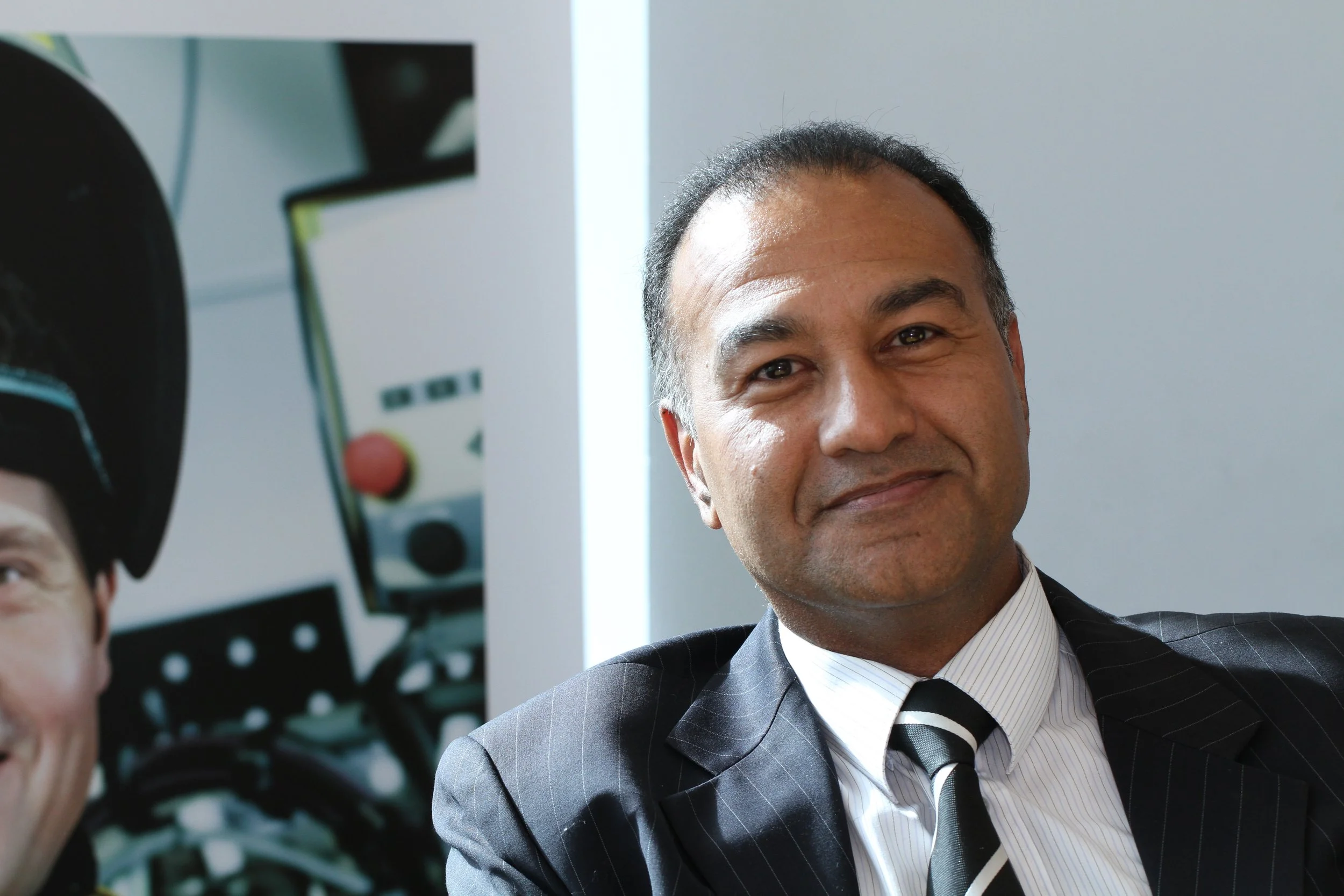
Interview with Nazmi Adams, (former) Global Marketing Director, ESAB
When Nazmi Adams joined ESAB in 2008, he initiated a process that would change the company from the inside out. Three years after the launch of an integrated brand development and Customer Focus programme, the figures clearly indicate that the strategy to focus on customer service was a winning one.
A company built on acquisition
Over the last 30 years, ESAB has grown both organically and through acquisitions. The company, which was founded in 1904, is based on the invention of the covered welding electrode — the brainchild of Oscar Kjellberg. In 1994, ESAB was acquired by Charter International Plc, a UK-based investment company listed on the London Stock Exchange. At the time of the acquisition, ESAB was truly a multi-brand company, but by the end of 2008 the company had committed to a process to convert acquired brands to the ESAB brand — which coincided with the recruitment of Nazmi Adams.
– ESAB had bought companies in various markets over the years and even though there was a reasonable alignment of how the brand was rolled out, at that point in time it was not consistent. So one of my key objectives was to become more consistent in terms of how we approached the market, and, on the flip side, our customers needed to have a consistent but also a more value-added experience from us, explains Nazmi Adams.
Increased competition from China
The welding industry has traditionally been dominated by a handful of major players such as ITW, ESAB and the American-based Miller and Lincoln. But the situation is changing and while ESAB still holds a strong position on the global market, there is increased competition from new players from other parts of the world, making competition fierce for the traditional players.
– To a large extent it is still a battle between a few but finite number of global players, but on the increase in this environment is the role of Chinese competitors. Recently we have seen Chinese competitors playing a much greater role on the global arena. However, bear in mind that most of the major global companies like ourselves also own stakes in Chinese manufacturing companies. It is therefore not just Chinese manufacturers — it is also Western-based Chinese manufacturing companies that are doing quite well, says Nazmi Adams.
The difference needs to be in the Service
As with many industrial companies, ESAB was traditionally a product-oriented company where R&D and marketing processes were geared towards developing and selling physical products. In a more competitive market it has come to the point where it is harder to win business contracts based solely on product performance and attributes — the reason being that today products can easily be copied by competitors and produced in countries where labour costs are lower.
"The world is moving forward in terms of the ability to produce these products, and consequently for the bulk of our products, the difference is not necessarily going to be in the product. The difference has to be in ourselves and in the services we provide."
— Nazmi Adams, Global Marketing Director, ESAB
– ESAB has traditionally been very much a product-oriented company. This has paid off since we have developed excellent products, which have brought us to where we are today. But going forward, the war on products is not going to be easily won in that arena — quite frankly many companies can make what we do, says Nazmi Adams.
Implementation of a customer focus programme
To meet the new challenges in the market, ESAB initiated a strategic process to enhance the company's focus on their customers. As with most product-driven companies, this proved to be easier said than done. To succeed the company needed to change from the inside — not only through its culture, but also the way it does business.
– When we looked at the market we saw that there was a distinct niche for a company that genuinely wanted to focus on the customer. No competitor had adopted this position. We therefore initiated a programme declaring our intention to start an internal transformation and become a customer-focused organisation. However, this is not easy to accomplish in an organisation where the product is everything, explains Nazmi Adams.
Challenge to sell the strategy internally
When a company faces the fact that it needs to transform its business from the very foundation on which it is built, this naturally creates questions and discussions about the what, the why and eventually the how and who. Nazmi Adams remembers that there was a lot of selling in the initial phase.
– I think the first challenge was to create understanding. The initial reactions I got were: "what on earth are you talking about?" Most people interpret customer service to be — "I will come and fix your welding machine when it is broken." Many people think of service as an in-service technician. So getting the language flowing was quite crucial. A journey such as this is similar to a journey in pursuit of a religion. It is a combination of initiating some rituals as well as the process of getting people to believe. But as with all religions, it is a bit of a slow start, then gaining momentum and all of a sudden arriving at a point where things are as they should be.
– The second challenge is to create a common understanding of why this needs to be done. My recommendation is to open the discussion with the alternative strategies that you can go forward with — become the product leader, become the leader in efficiency, or the leader in customer relations. These are the three main basic strategies. You can only be the best on one dimension, but you cannot relinquish the other two. Can we produce more efficiently than others? The Chinese will always win this. Or should we focus on offering our customers better service than everyone else? At this point we came to an obvious conclusion, says Nazmi Adams. This is when and how I got it on the strategic agenda.
– The third challenge, and probably the toughest, was to get R&D people to really apply their minds to what is sometimes obvious. There is always a tendency with R&D people to dive into something that is complex and exciting. Sometimes the solution is a lot simpler than that. Because of our Customer Focus programme we needed to change the mindset of the R&D department — to recognise new challenges and be able to look at the welding industry customers in a whole new light, asking instead: "What solutions do I need to offer this person or business to be able to gain their loyalty and trust? What value can I add?"
A global vision for the brand
To support the Customer Focus transformation programme, ESAB started by defining a global vision for the ESAB brand. The vision stated that ESAB should aspire to be the global leader, the customers' preferred partner and the global authority in welding and cutting. To engage the organisation in the journey ahead, Nazmi Adams initiated an internal dialogue to define the core values of the company.
– We had lots of fun defining the values, because when discussing values one can get quite esoteric and everyone has an opinion. We therefore carried out an internal process to determine which values the organisation thought would support us on the journey to where we want to go, and at the same time allows us to be true to who we are. Internally, the words people intuitively associated ESAB with were: Integrity and Experience, Innovation and Partnership, says Nazmi Adams.
Bringing out the people behind the technology
To succeed with the transformation, Nazmi Adams was convinced that the company also had to shift its focus from products to people. When a company goes from a brand-building process where product features are the major vehicle for the brand, to one based on service delivery, the human characteristics and behaviour of its people become much more crucial in creating the perception of the brand.
"Welding has always been seen as engineering technology. One of the things that I really wanted to do was to bring out the individual behind the technology. Our divergence was to say that this is actually a people business."
— Nazmi Adams
– Whenever there is a welding problem there is an individual who comes to your assistance. His name could be Joe. He has experience, he has knowledge, which is in him as a person, and he is supported by several others just like him at ESAB. The message is twofold — one being that ESAB is about people directed to customers, and the second is a message saying that it is a good thing to become one of these people. Join the industry! We want people to think: "I am going to join the industry, and I am going to join ESAB."
Becoming a preferred partner
Through the expressed ambition to become the customers' preferred partner, the vision also describes the kind of relationship that ESAB aspires to have with its customers. The advantage of having both the brand personality and the relationship described in the vision is that it gives management a strong and common tool for guiding those inside the company toward the desired market position.
– A key part of the strategy is the partnership dimension. If you take our vision statement going forward, it really comes down to living our brand. We say our mission is to be a global leader — meaning we would like to be the biggest or second biggest. That is a clearly defined objective. The second part is that we would like to be our customers' preferred partner, meaning we partner our distributors and customers in terms of all the bits and pieces that it takes to be successful in our business.
Need to earn the position as authority
There were some internal discussions concerning the definition of ESAB's brand personality. Some expressed concerns about "Authority" and considered it to be a personality statement that went against the culture that already existed within the company. Others claimed that Authority expressed the true personality of ESAB because it sums up the high level of expertise and experience that ESAB holds within its market.
– The last cornerstone of the platform expresses our desire to be perceived as the authority in welding and cutting. By this we mean that we would like ESAB to be held in the same esteem as the person you turn to when you have a problem. It is not the arrogant or statutory meaning of authority. It is simply saying — if someone has a welding problem they will say: "we need to go to ESAB." This perception will make us the preferred supplier in many cases when customers are faced with significant challenges. The advantage for the companies that partner up with us is that they will get a better quote and will also make more profit. It is a win-win situation, says Nazmi Adams.
Localisation — The new globalisation
To become a truly global company, ESAB rolled out the values in the organisation with the clear message that this was not to be used as a statement dictating exactly how people should behave in certain situations. The platform was to be interpreted in a local context and adapted to best suit the local situation.
– I do not believe that it is right for us to say to every person around the world that this is exactly the only way to do things. I think that kind of approach will just hold back the organisation. Basically there is a global parentage that indicates what the ESAB brand is and what it stands for, but it needs to assume a local character. Because integrity in China, integrity in the USA, integrity in Germany is understood as the same thing, but the reaction it evokes is very different, explains Nazmi Adams.
Making the next level of managers own the strategy
To get commitment going internally, ESAB involved the company's prospective managers — the people who are going to be the next leaders of ESAB. Top management saw this as an opportunity to develop the next corporate level, a total of 15 individuals across the globe.
"Being customer focused means you get to choose the customers you are going to focus on. It does not mean we should focus on every customer."
— Nazmi Adams
– As part of our leadership development, we simply gave them the task to crystallise for the organisation what ESAB means by Customer Focus, and how we should approach the market. After spending six to seven months debating amongst themselves and getting the answers and the language right, the group of managers appointed owned the issue of Customer Focus. After the process, each one became a champion and a point of reference and was able to take the programme forward in every country that they represented, says Nazmi Adams.
Involving the customer as partners
When the segments that ESAB wished to focus on had been identified, a specialist team very familiar with those segments was appointed. Because of their expertise they could initiate a discussion with customers and ask what their needs really were. The discussions focused on how to integrate solutions and applications in order to improve the customer's productivity, profitability and competitiveness.
– Some of the ideas that we came up with are frankly quite remarkable. For example, we can now go to a customer and say that the layout of his plant is not ideal — and present him with a solution. Instead of making five units a day we can actually have him make seven units a day for the same level of investment and personnel. The result is better returns on working capital, reduced level of investment, with no need to hire more people — the outcome being reduced operating costs. Now, that gets the customer going! says Nazmi Adams.
Creation of a "Value Sell" department
To take the Customer Focus transformation process as far as possible also means taking the necessary steps to change the organisation and invest in new skills. To concentrate the know-how for selling value-added service in one place, ESAB created an entirely new department.
– We put together a Value Sell department that, among many things, has the capability to analyse the production costs all the way through our customer's production process. Based on existing data supplied by the customer, we can act as consultants giving our customers advice on a totally new level. We are now able to advise our customers to change their welding procedures in their production and show them how much they can save or how much more they can produce by taking specific actions based on our analysis, says Nazmi Adams.
Customer at the centre of the organisation
After having run the Customer Focus programme for about three years, the results are becoming manifest not only in how the organisation thinks and acts, but also from the market research and financial numbers that clearly indicate this was the right path for ESAB to take.
– First of all, Customer Focus is right at the top of our strategic agenda and I do not need to drive it so hard anymore. It is now entrenched in our culture and in our language. The message has got through and all I need to do is support it. Secondly, there is less debating about certain things. If I say that I need to invest in people, HR and the finance department jump on the bandwagon much easier because we all recognise the necessity. Now we focus more on identifying what is holding us back from taking Customer Focus further and what we can do to continue to increase our sales efficiency.
Measuring success
Where many companies try to save money by cutting down on market research, ESAB goes in the opposite direction, in line with the statement: "what is measured, gets done." ESAB has conducted extensive market research around the globe and Nazmi Adams is very pleased with the results.
– How do we know we have succeeded? The only way you know is by asking your customers. We have just completed two types of market research — one customer satisfaction research, and one recognition and image study. We have probably covered most of the major markets in the world: Brazil, Argentina, the US, Canada, Mexico, Germany, the UK, the Czech Republic, Poland, Norway, Singapore, and China. Looking at the results, it is remarkable how consistent the ESAB brand is now perceived around the world. The one measure I am most proud of is the extent to which our customers would recommend us — ESAB comes out well ahead of everyone else. This is a very strong loyalty measure because it is right at the heart of trust. No one will recommend a supplier they do not trust, Nazmi Adams concludes.
About the company
Founded in 1904, ESAB is a focused premier industrial compounder. The Company’s rich history of innovative products, workflow solutions and EBXai, enables its purpose of Shaping the world we imagine™. ESAB is based in North Bethesda, Maryland and employs approximately 10,300 associates and serves customers in approximately 150 countries.
Leading Brand-Driven Business Development — Leadership Perspective
From a brand perspective, as a business leader you must ensure that the organisation has a customer-focused approach and that the company's offering is aligned with its brand strategy.
Challenges
Creating conditions for the organisation to shift focus from transaction to relationship.
Daring to question the prevailing business model.
Focusing on the right customers.
Critical Success Factors
Developing routines to capture trends and underlying drivers, and translating these into innovative, differentiating solutions.
Conducting effective and relevant needs-based segmentation.
The ability to bring R&D into the service development process.
Ensuring the development of long-term partnership relationships with customers and collaborators.
The ability to package and sell services — value selling.